Projects
A collection of projects I've worked on and things I'm currently working on. If you are interested in working with me, please reach out!
active
Computational tools for understanding changes in cell identity

Many biological systems and processes rely on phenotypic heterogeneity– a mix of cell identities within a single system– such as disease states like cancer and organ systems like the pancreas. Over time, these cell identities may evolve in response to perturbations (such as cancer therapy) or intrinsic and extrinsic signaling (like external cues to differentiate into a new cell type). I am interested in developing computational tools that investigate these signals. Matrix factorization methods, like archetype analysis and NMF, play a large role in phenotype identification, and answer the question: what cell identity reference points are useful in my system of interest? Once reference clusters or archetypes are identified, dynamics of those groups can be analyzed. Predicting perturbation to cellular identity through mutations, epigenetic silencing, or overactivation relies on understanding the dynamics of an underlying gene regulatory network, so network inference can answer the question: what effect does a particular drug or chemical signal have on my system? If you are interested in building cell identity matrix factorization and GRN inference tools, please reach out via email!
Related tools
- BoBa-T: GRN inference for scRNA-seq
- BooleaBayes: Boolean Network Inference Toolkit
- Mazebox: Single-cell Transcriptomics Analysis Pipeline
Related papers
- Systems-level network modeling of Small Cell Lung Cancer subtypes identifies master regulators and destabilizers. PLOS Computational Biology, 2019.
- Archetype tasks link intratumoral heterogeneity to plasticity and cancer hallmarks in small cell lung cancer. Cell Systems, 2022.
- Quantifying cancer cell plasticity with gene regulatory networks and single-cell dynamics. Frontiers in Network Physiology, 2023.
Epigenetic heterogeneity and plasticity of Small Cell Lung Cancer
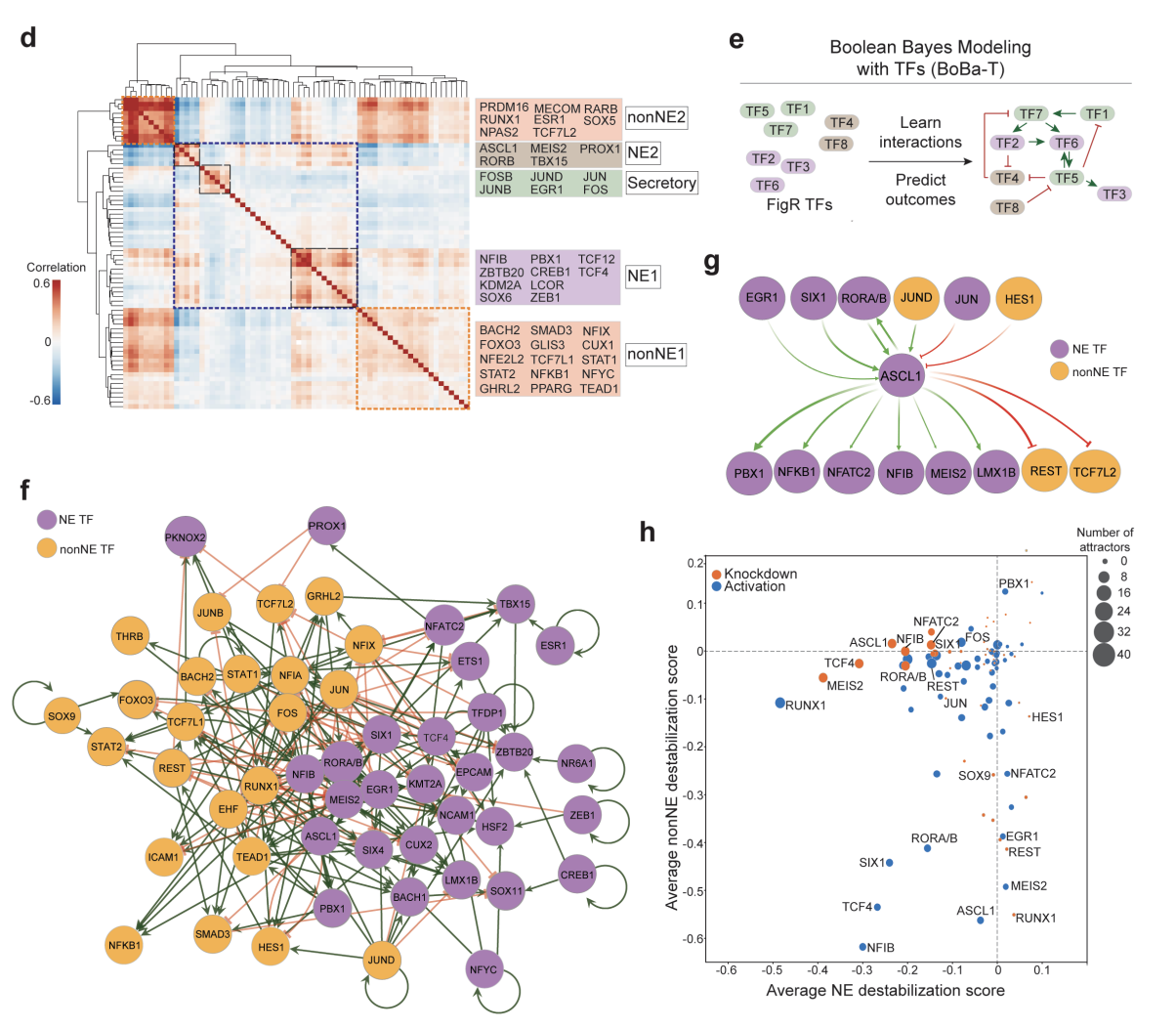
SCLC is a highly aggressive form of lung cancer that initially responds well to treatment but quickly comes back in almost all patients. One reason we think it may come back is a high degree of phenotypic heterogeneity and plasticity, meaning the cells are intrinsically able to “shape-shift” in response to drug treatments to avoid them. I build and use computational tools that investigate the underlying mechanisms of SCLC plasticity. My focus is combining ODE modeling, Boolean network simulations, and experiments with collaborators to figure out better ways to categorize and treat this type of cancer.
Related tools
- Network Explorer: Upload a network as CSV, then group and color nodes by any attribute. Includes SCLC TF networks from Wooten, Groves et al. (2019) and Bhattacharya, Groves et al. (2026).
- SCLC Phenospace: Explore the GO biological processes enriched in SCLC gene modules and which subtype each module is high in. Interactive Fig. 3B–C from Wooten, Groves et al. (2019).
- SCLC Subtype Map: How published SCLC subtyping schemes (classic/variant, NE/non-NE, A/N/P/Y, A/N/P/I, archetypes, clusters, NMF groups) map onto each other and onto the current A, A2, N, P, Y, I and At states.
Related papers
- Archetype tasks link intratumoral heterogeneity to plasticity and cancer hallmarks in small cell lung cancer. Cell Systems, 2022.
- Systems-level network modeling of Small Cell Lung Cancer subtypes identifies master regulators and destabilizers. PLOS Computational Biology, 2019.
Network control and condensate formation of mitotic proteins in breast cancer
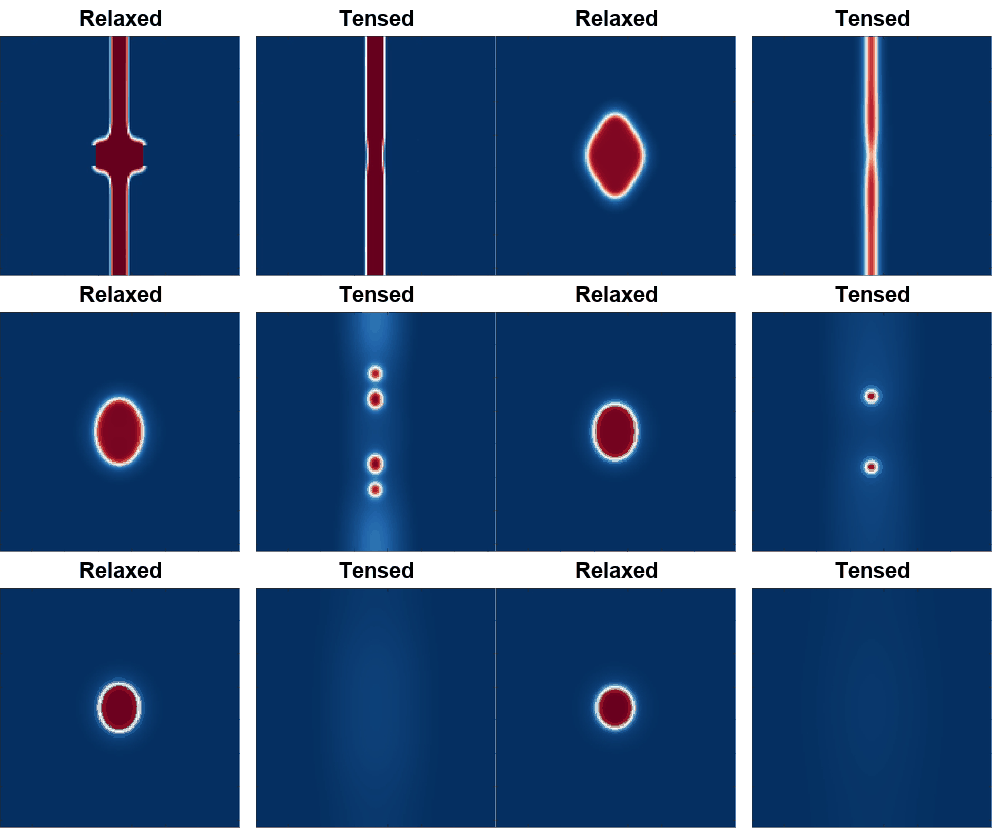
Cells can organize subspecies into compartments without using membranes. Membraneless organelles, or “biological condensates,” are like liquid droplets of proteins that interact weakly at the molecular level, forming a high-concentration phase. The process of this droplet formation, called liquid-liquid phase separation (LLPS), can be modeled by Cahn Hilliard equations: differential equations that define the dynamics of the two phases, taking into account the formation of the interface between them. We built numerical solvers for these equations that are applicable to any biological system that phase separates, and then applied the solvers to our interest in mitotic proteins that promote proper chromosomal segregation. Without condensate formation and proper signaling, the network underlying chromosomal segregation can fail, leading to aneuploidy and cancer.
Code on GitHub for CPC condensate dynamics
Related tools
- Cahn-Hilliard Solvers: Nonlinear multigrid and scalar auxiliary variable solvers of the Cahn-Hilliard equation (MATLAB, Julia, Python)
Related papers
- Cell-specific Cahn-Hilliard models predict condensed fates of the chromosomal passenger complex. PLOS Computational Biology, 2026.
Public Transit and Transportation Infrastructure Networks
I am helping to develop a new public transit project. Stay tuned!